All workProject 6 of 7
Fair badminton nights, no peg board.
- Year
- 2026
- Role
- Product, engine & desktop app
- Platforms
- Windows, Desktop, Offline
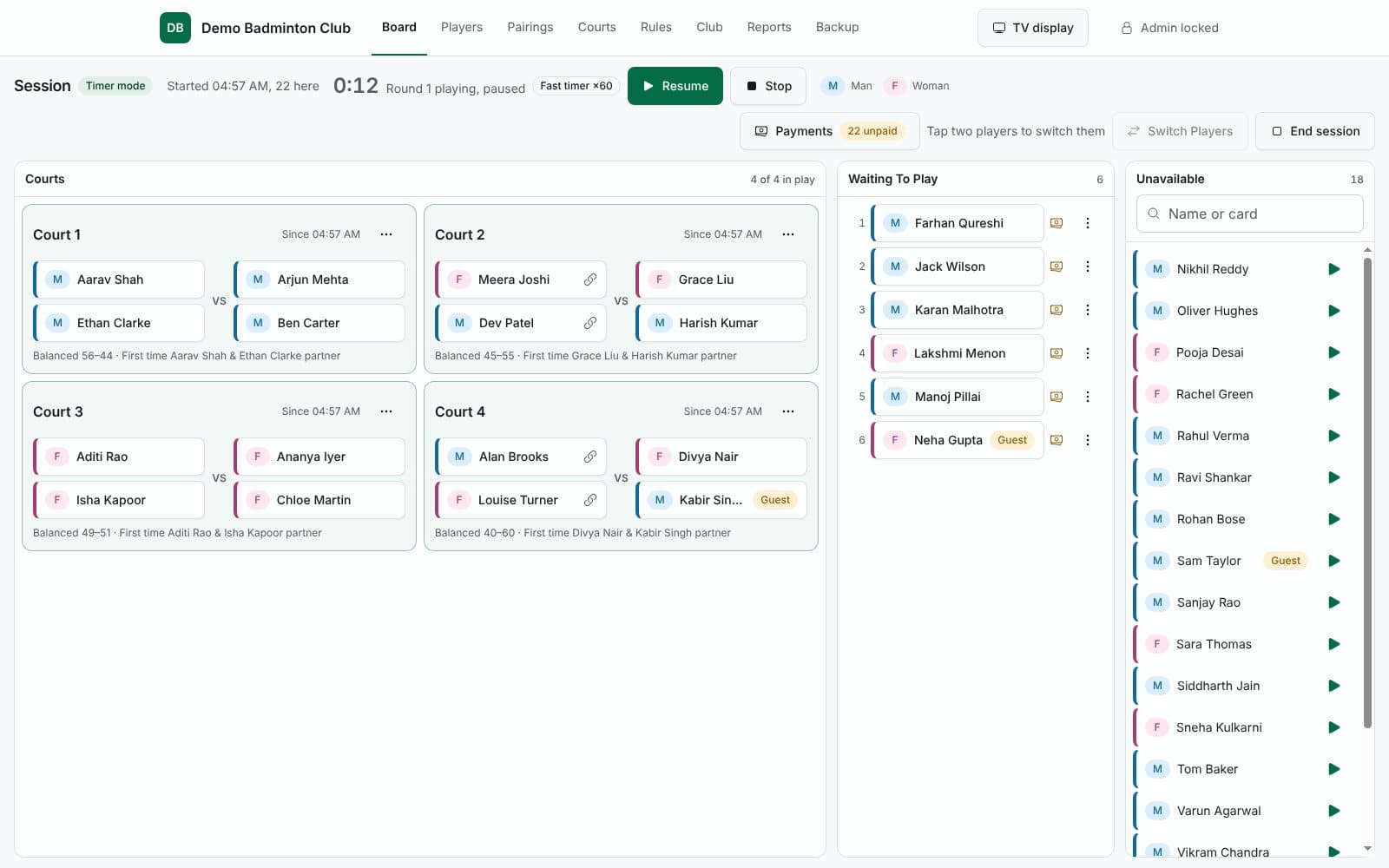
Clubs still rotate players with a peg board. It isn’t fair, and everyone knows it.
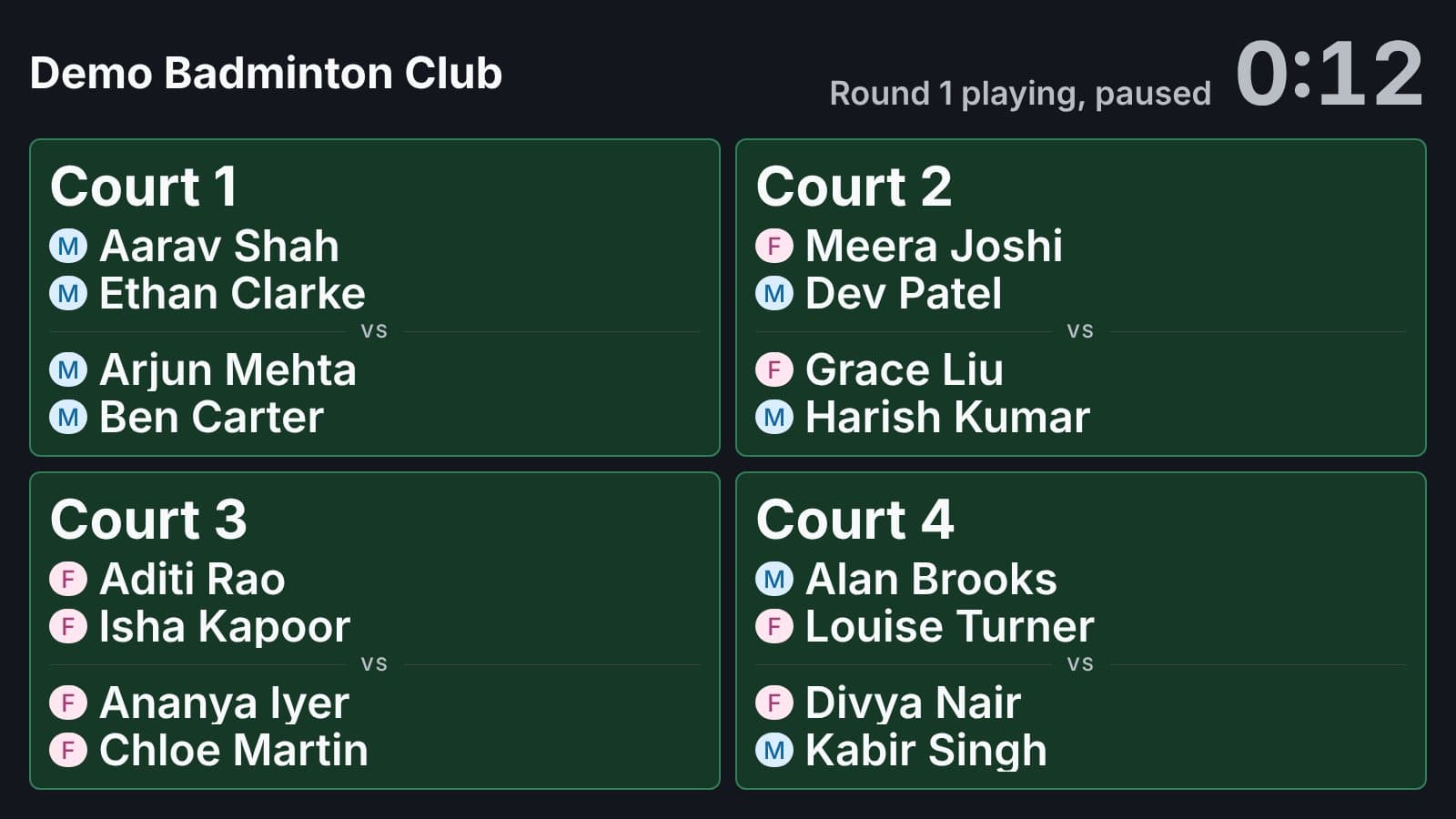
A peg board depends on one volunteer, gives uneven court time, repeats the same partners and produces lopsided games. CourtPilot replaces it with a desktop app that checks players in, picks balanced and varied foursomes automatically, puts them on courts and shows the result on a big screen — all evening, with zero internet.
I wrote the functional spec and engine spec, then built the whole thing: the allocation engine, the SQLite data layer, the Electron app, the TV display, licensing and the Windows installer.
- Role
- Spec, engine, desktop app, packaging
- Built
- 15 → 16 Oct 2026, M0 → M10
- Platform
- Windows desktopoffline
- Users
- Club admins, volunteers, players
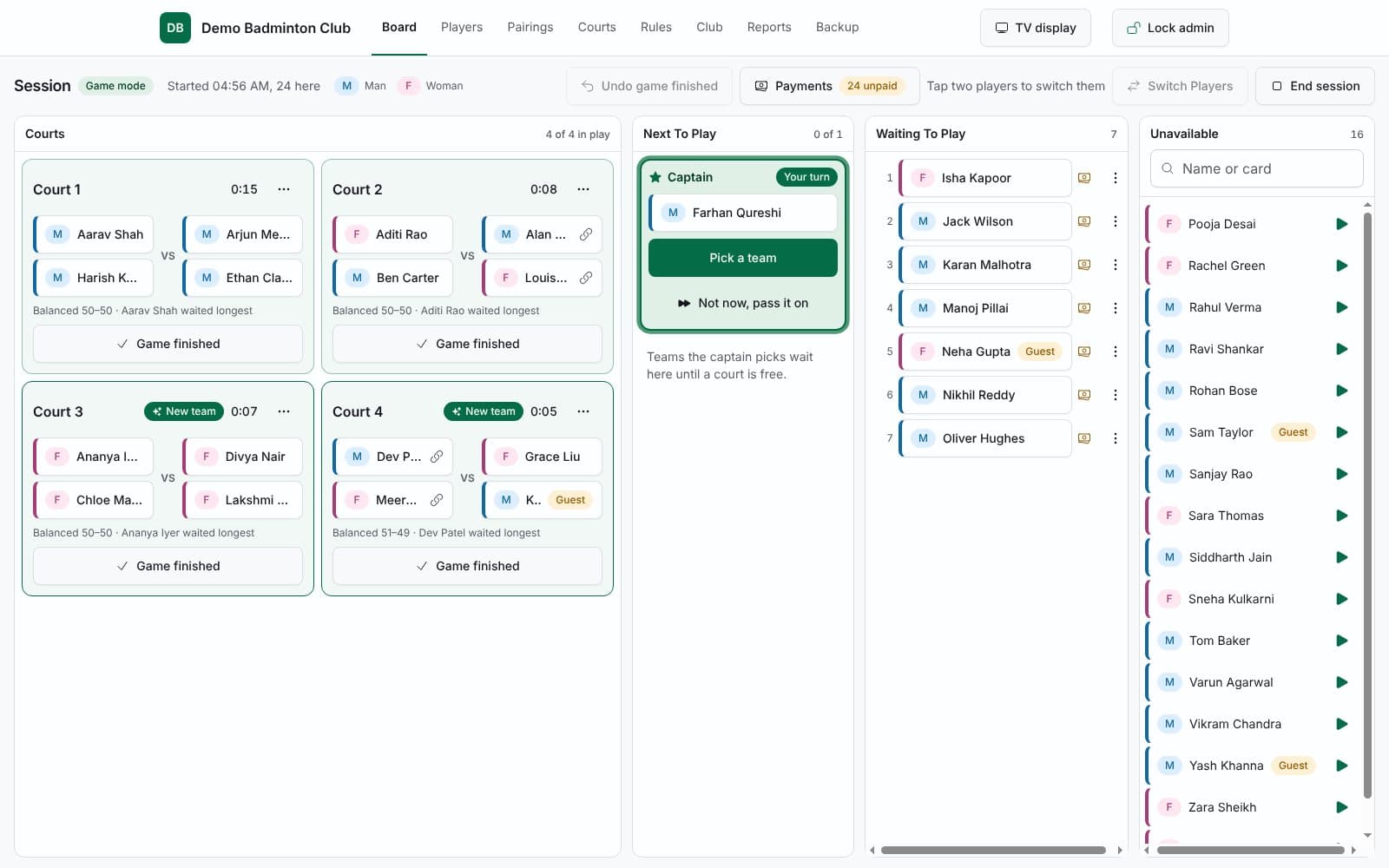
One board for the operator, one screen for the hall.
03Features
Built around a fair pick
Every screen hangs off one question the engine answers in under 200 ms: who plays next, with whom, and against whom?
- Engine
Balanced, varied foursomes
A weighted cost — predicted balance, skill spread, partner and opponent repeats, mixed ratio, fixed pairings — scored over every split, then a greedy build and seeded local search.
- Ratings
Skill that learns
Players start from an admin grade of 1–10; OpenSkill ratings update after every result, so the engine’s idea of “even” sharpens week by week.
- Explained
Every court says why
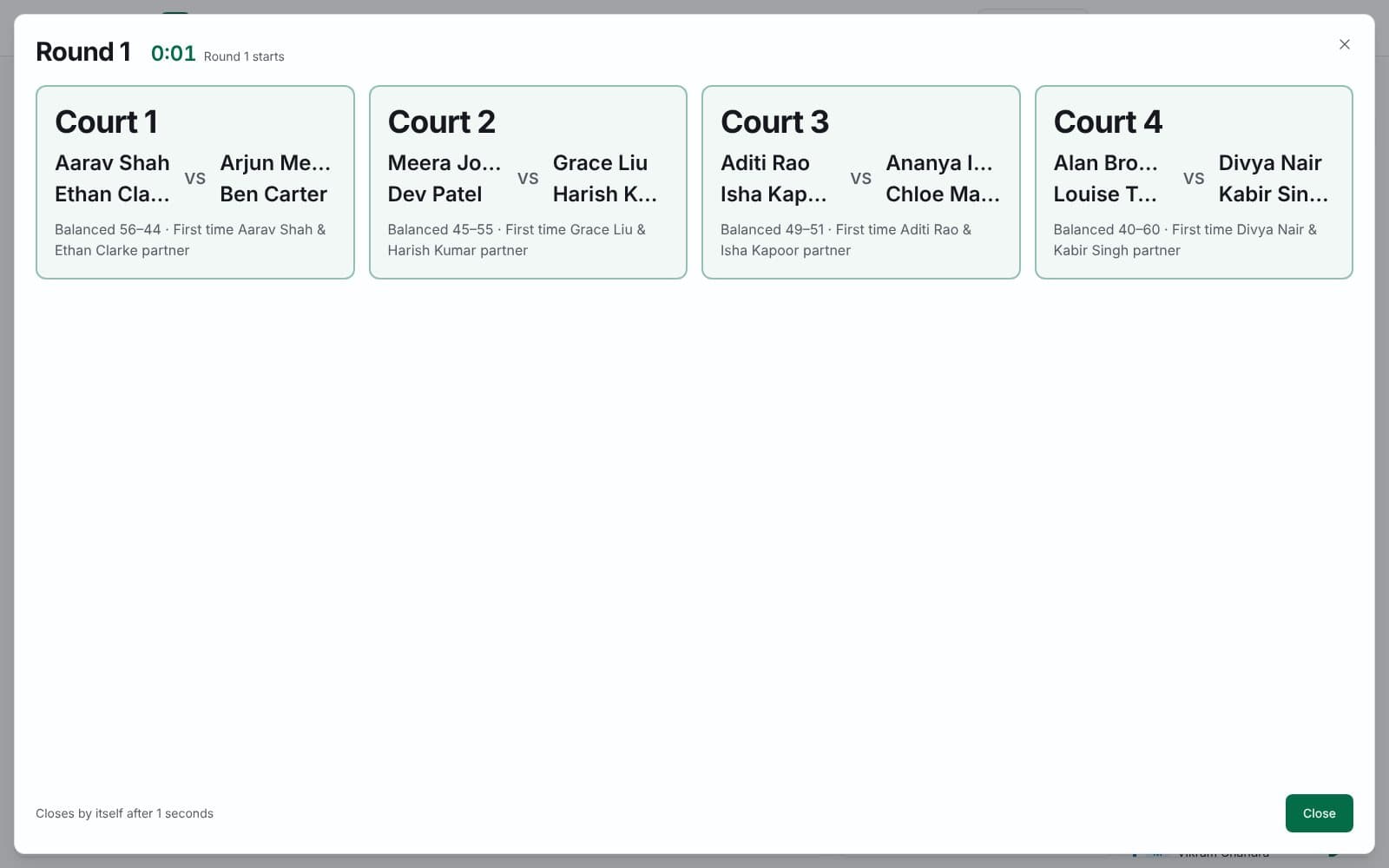
“Balanced 50–50 · Ana waited longest · First time Ana & Ben partner” — a short reason under each court, so nobody has to ask the volunteer.
- Two modes
Timer or game
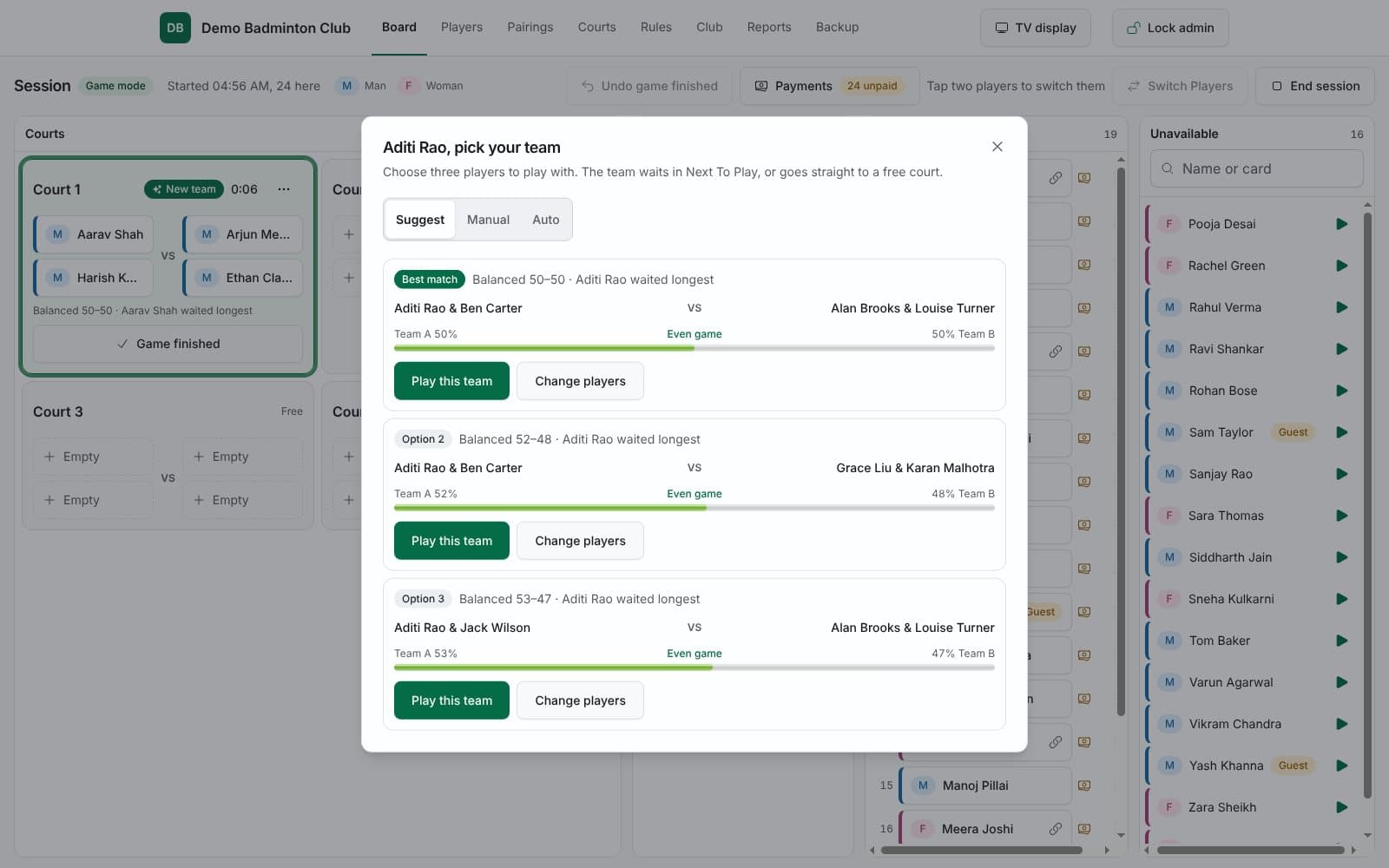
Timer mode rotates every court together on a countdown. Game mode lets the captain pick a team — Suggest, Manual with live balance, or Auto — and courts turn over as games end.
- Overrides
The operator always wins
Drag players between courts, switch two players, lock a court, pause a player or sit them out, and undo — every change written to the database first.
- Club admin
Everything a club night needs
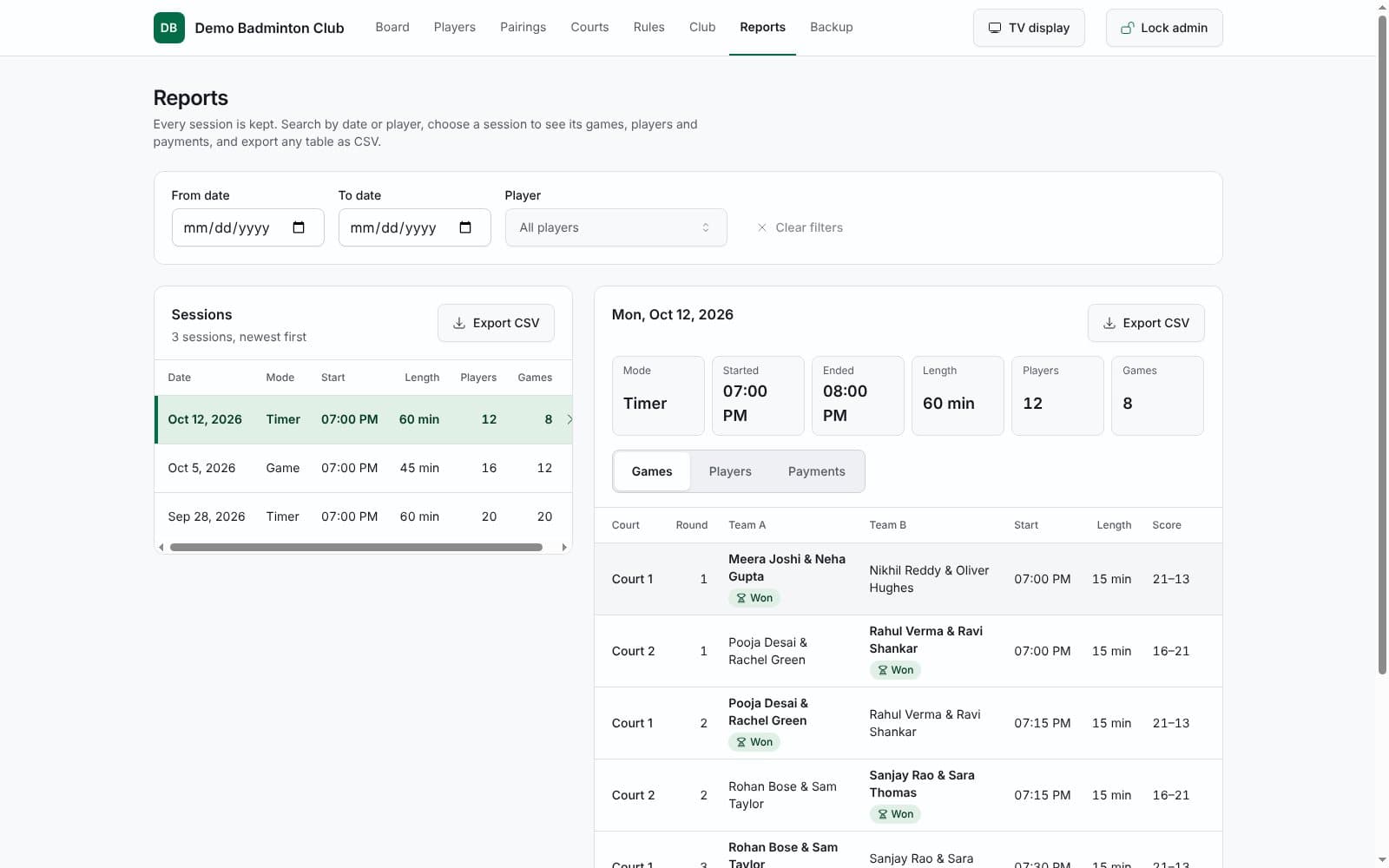
Barcode check-in cards and a USB scanner, CSV import, pairings and rules, fees by cash, card or UPI, reports with CSV export, and backup to a USB stick.
A pure engine, a database that is the truth
The engine is plain TypeScript with no I/O: time, the random seed and all state are passed in, so the same input always gives the same pick. The renderer never touches Node or the database — only typed tRPC procedures over Electron IPC. Hover a node to trace its connections.
01Screens
Admin boardReact 18check-in · courts · overrides · admin
TV displaysecond window · read-only
02Main process
tRPC over IPCzodcontextIsolation · no Node in renderer
Timer + scannerrounds turn in main · USB barcode
03Core
Allocation enginepure TSpickRound · suggestForCaptain · OpenSkill
RepositoriesDrizzle · one transaction per action
04Data
SQLiteWAL · synchronous FULL · crash recovery
01
Offline is enforced three ways: a CSP, a request filter that cancels anything not bundled, and lint bans on fetch and WebSocket.
02
A crash test SIGKILLs a live session mid-round; the recovered state is byte-identical.
05Tuning
Tuned by simulation, not by feel
Each simulated player gets a hidden “true skill”, results are decided by a logistic function of the skill gap, and whole sessions are replayed on fixed seeds. The acceptance bar is strict: games-played spread of at most one, nobody sitting out two rounds in a row, 80% of courts inside 40–60 predicted balance, no partner pair repeating more than twice, and ratings that rank players by true skill with a Spearman correlation of at least 0.8.
The spec’s default weights failed it — at the original selection penalty, balance won and some players fell three or four games behind. The fix was to raise three weights, confirm them on fresh seeds, and record every trade-off. Game mode got its own weights after the sim showed a fixed captain plus a FIFO queue can never hit the timer-mode bar; its threshold is now measured against a plain queue on the same seeds.
Every session is kept.
Spec to signed installer
0 milestones (M0 → M10, two days), 0 unit tests (Vitest · engine, db, app), 0 end-to-end tests (Playwright against Electron), < 0 ms pick budget (16 courts · 100 players), 0 sim scenarios (fairness · balance · learning) and 0 network calls (offline, enforced).
Counted from the repo, the engine spec and the simulation suite.
Stack.
- App
- Electron 44
- React 18
- Vite
- TypeScript (strict)
- Tailwind v4
- shadcn/ui
- Zustand
- dnd-kit
- Core
- electron-trpc
- zod
- SQLite
- better-sqlite3
- Drizzle ORM
- OpenSkill
- Quality + delivery
- Vitest
- Playwright
- electron-builder (NSIS)
- electron-updater
- Ed25519 licences
How it came together
11 Oct
Spec first
A functional spec split into MVP and Full Product, an engine spec with every cost term and acceptance threshold, and eleven milestones.
15 Oct
Engine + simulator
Ratings, timer-mode picks and game-mode suggestions as pure TypeScript, tuned against the simulation suite before any UI existed.
15 Oct
Data layer
Drizzle schema, embedded migrations, repositories, tRPC routers and crash recovery from rows, not snapshots.
16 Oct
Board, modes, TV, reports
Check-in and overrides, timer and game mode end to end, the TV display, payments, reports and backup.
16 Oct
Ship it
Offline Ed25519 licence activation, auto-updates, a soak test of four session-hours, and a signed one-click Windows installer.
Next project

prmpt
A drop page you steer with the cursor.